1Overview
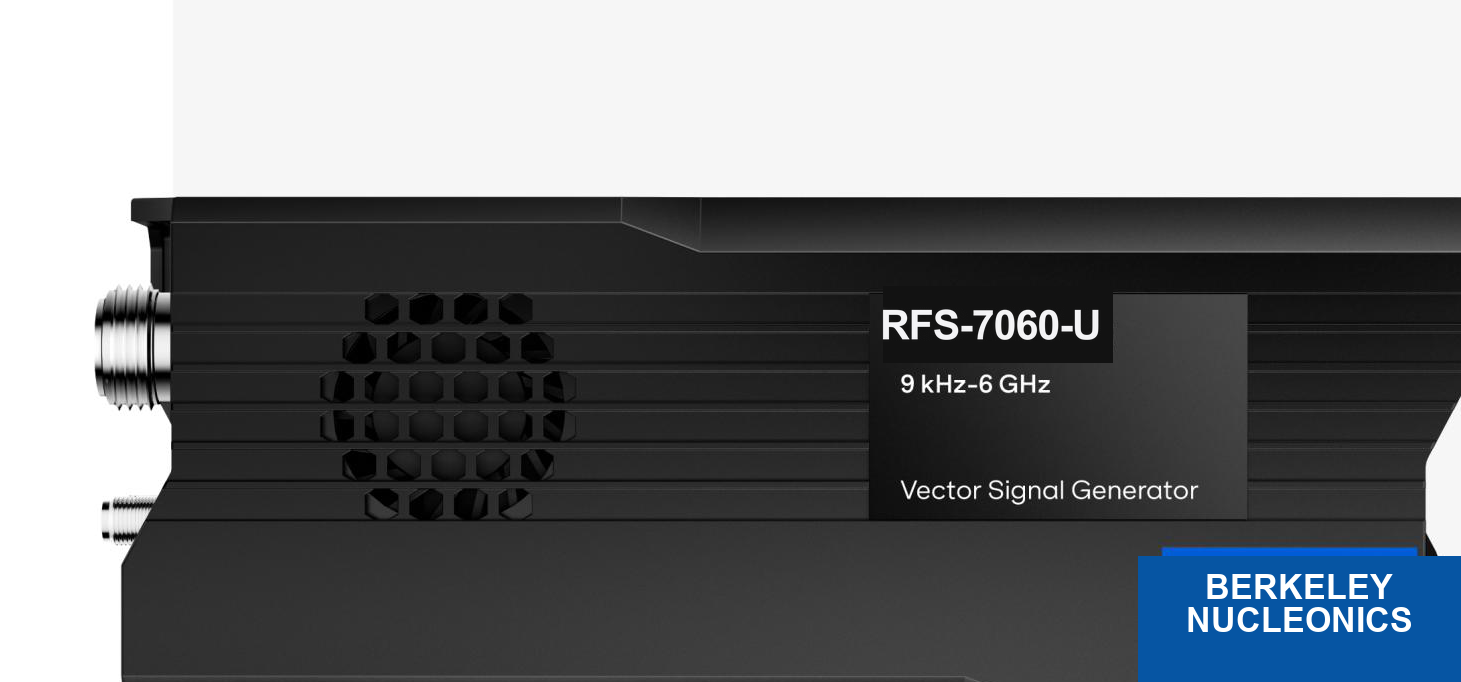
The Berkeley Nucleonics RFS-7060-U is the second vector signal generator in the BNC RF and microwave line, sized to sit beside a laptop rather than fill a rack. It generates continuous-wave, swept, and fully vector-modulated signals from 9 kHz to 6 GHz, and it draws power and data over a single USB Type-C cable.
Inside the compact housing, a 16-bit DAC and an FPGA-based interpolator build clean waveforms with 100 MHz of modulation bandwidth (320 MHz with option 53) and 128 MB of playback memory (1 GB with option 53). The interpolator gives fine, granular control over sample rate while minimizing host CPU load. That combination supports single-tone work, frequency and power sweeps, stored IQ playback, and real-time IQ streaming from a host. An optional built-in GNSS receiver disciplines the reference for timing, positioning, and frequency calibration in the field.
The RFS-7060-U suits benchtop R&D, production test, and portable field work where a full-size generator is more instrument than the task needs. It runs on both Windows and Linux, on x86 and ARM hosts, so it fits embedded and automated setups as readily as a desk.
Definitions
- Guaranteed: warranted performance, verified by design and production test under the stated specification conditions.
- Typical: expected mean performance, not a warranted limit.
2Key Features
- Frequency: 9 kHz to 6 GHz continuous coverage.
- Modulation bandwidth: 100 MHz playback / 320 MHz playback (opt.53, new), 50 MHz real-time streaming.
- Memory depth: 128 MB (32 M samples) built-in, 1 GB (opt.53, 256 M samples).
- SSB phase noise: -132 dBc/Hz guaranteed / -134 dBc/Hz typical (10 kHz offset, 1 GHz carrier).
- Output power: 9-16 dBm maximum depending on frequency; 25 dBm with the medium power option (opt.10); minimum down to -100 dBm or below across the range.
- Harmonics: ≤-60 dBc typical (0 dBm).
- Converter: 16-bit DAC with an FPGA-based high-performance interpolator.
- Sampling: fine sampling-rate and reference-frequency adjustment.
- Timing: optional built-in GNSS for timing, positioning, and frequency calibration.
- Interface: USB 3.0 / 2.0 over Type-C, with PD power on the same connector.
- Hosts: Windows and Linux, on x86 and ARM processors.
- Spurious: ≤-85 dBc typical.
3Software and Control
The VectorCore Studio application drives the RFS-7060-U from the host. It consolidates RF parameter control, mode selection, mode parameters, and real-time status into a single main window, organized into five functional areas: menu bar, RF parameter settings, mode selection, mode parameter settings, and status information. The unified layout shortens the learning curve and gives operators a workflow comparable to traditional benchtop instruments. A documented API supports C/C++, C#, Python, and MATLAB, plus Qt, LabVIEW, and GNU Radio, for automated and cross-platform use. Full operating instructions are in the VectorCore Studio User Guide, shared with the RFS-7060-T.
RF Frequency and Power Sweep Control
VectorCore Studio supports single-point, frequency-sweep, and power-sweep modes. Operators can run automated frequency-response and compression-point characterization directly from the interface, without writing custom control code.
Real-Time IQ Playback
The instrument supports continuous real-time waveform streaming from the host, or buffered playback from on-device memory. Playback mode provides higher signal bandwidth and runs without host intervention, fully offloading host processing. In replay mode, the maximum waveform length is bounded by the internal memory capacity.
4Signal Generation Modes
Digital Modulation (Option 73)
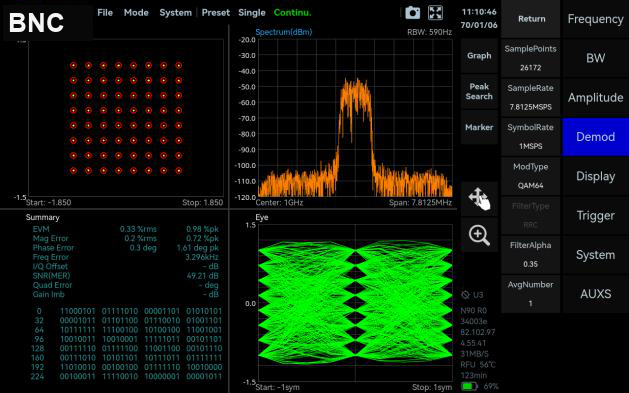
An extensive modulation library spans fundamental ASK, FSK, and PSK through high-order 1024QAM. Native support for DSSS and OFDM targets modern wireless standards for field testing and R&D verification.
AM / FM
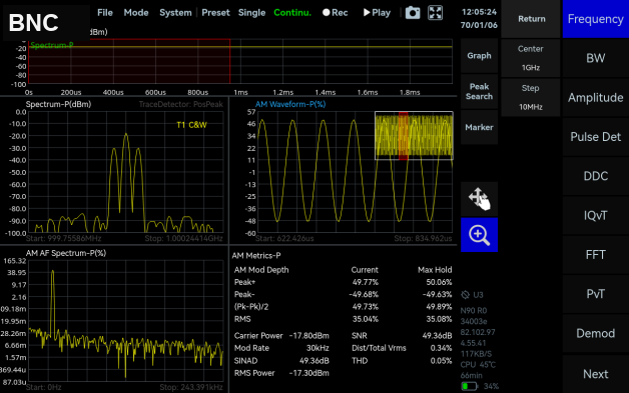
Classic analog modulation with high-precision control of modulation frequency, depth, and frequency deviation, for traditional receiver testing and analog system verification.
Pulse
Integrated pulse generation with configurable pulse repetition period, duty cycle, and pulse width, for timing-sensitive, pulsed-RF, and radar-signal simulation.
Multitone
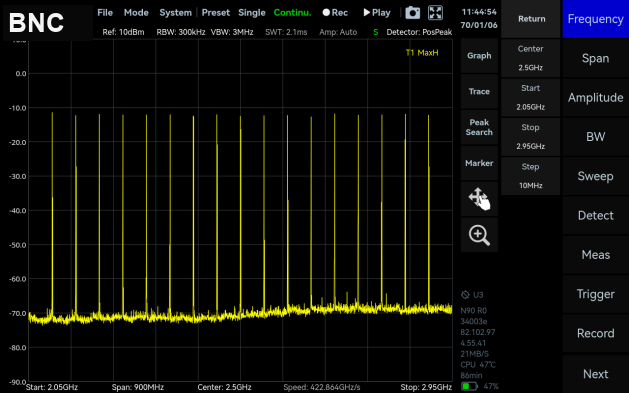
Composite signals with configurable tone count, tone spacing, and phase mode, plus a definable in-band notch. Suited to dynamic-range, intermodulation-distortion, and flatness testing.
Digital Ramp Sweep
Linear frequency-modulated (chirp) generation with flexible sweep width, sweep time, and sweep period, for radar simulation, wideband excitation, and frequency-response testing.
Medium Power Output (Option 10)
An optional medium-power RF port delivers up to 25 dBm from 10 MHz to 6 GHz for applications requiring higher excitation levels, such as device testing and joint debugging. Full specifications are in Medium Power Output (Option 10) below.
5Frequency
| Parameter | Specification | ||
|---|---|---|---|
| Frequency range | 9 kHz to 6 GHz | ||
| Frequency resolution | |||
| Output frequency <500 MHz | 1 Hz | ||
| 500 MHz ≤ output frequency ≤ 6 GHz | 0.1 Hz | ||
| LO switching time | ≤100 us pre-programmed; ≤50 ms software controlled | ||
| Reference clock | Internal or external; manual correction or GNSS calibration available | ||
| Frequency accuracy | |||
| TCXO (std.) | ≤0.1 ppm, supports GNSS correction — OCXO-level accuracy now standard | ||
| OCXO correction via GNSS | ≤0.05 ppm, when GNSS is locked | ||
| Aging and temperature stability (TCXO, std.) | ≤0.3 ppm/year, ≤0.05 ppm (single spec) | ||
| Built-in GNSS 1PPS accuracy | ≤100 ns; ≤20 ns (opt.05) | ||
6Spectrum Purity
SSB phase noise (dBc/Hz, guaranteed / typical)
| Offset from carrier | 1 GHz | 3 GHz | 6 GHz |
|---|---|---|---|
| 1 kHz | -125 / -128 | -118 / -121 | -112 / -115 |
| 10 kHz | -132 / -134 | -124 / -126 | -118 / -120 |
| 100 kHz | -131 / -133 | -123 / -125 | -117 / -119 |
| 1 MHz | -141 / -143 | -131 / -133 | -125 / -127 |
Harmonics, spurious and EVM
| Parameter | Condition | Specification | |
|---|---|---|---|
| Harmonics (CW, 0 dBm) | |||
| 100 MHz | ≤-45 dBc | ||
| 1 GHz | ≤-60 dBc | ||
| 3 GHz | ≤-60 dBc | ||
| 6 GHz | ≤-70 dBc | ||
| Non-harmonic spurious | 1 MHz step size and 20 MHz observation bandwidth | ||
| Spurious levels are ≤-85 dBc for approximately 99% of frequency points | |||
| Worst-case spurious ≤-65 dBc | |||
| EVM (Typical) | |||
| 1 GHz | ≤0.3% 1MSPS QAM 16, Alpha = 0.35; ≤0.5% 10MSPS QAM 64, Alpha = 0.35 | ||
| 6 GHz | ≤0.5% 1MSPS QAM 16, Alpha = 0.35; ≤1.0% 10MSPS QAM 64, Alpha = 0.35 | ||
7Amplitude
| Parameter | 9 kHz | 100 MHz | 1 GHz | 3 GHz | 6 GHz |
|---|---|---|---|---|---|
| Max. output power (dBm) | ≥0 | ≥10 | ≥16 | ≥16 | ≥9 |
| Min. output power (dBm) | ≤-100 | ≤-100 | ≤-100 | ≤-100 | ≤-100 |
| Parameter | Condition | Guaranteed / Typical | |
|---|---|---|---|
| Power accuracy | |||
| Output power ≥-45 dBm | ±1.2 dB / 0.7 dB | ||
| Output power -80 dBm to -45 dBm | ±1.5 dB / 1.2 dB | ||
| Output power -100 dBm to -80 dBm | ±2.0 dB / 1.8 dB | ||
| Power setting step size | 0.1 dB | ||
8Signal Processing
| Parameter | Specification | |
|---|---|---|
| Standard function | Single-tone, Multitone, Frequency sweep, Power sweep, AM, FM, Pulse, Digital ramp sweep, AWGN, IQ playback, Real-Time IQ playback, PM (phase modulation) | |
| Modulation bandwidth | 100 MHz / 320 MHz (opt.53) playback; 50 MHz streaming | |
| Built-in memory depth | 128 MB (32 M samples) / 1 GB (opt.53, 256 M samples) | |
| IQ sampling rate | 195.3125 kHz to 200 MHz; 300-400 MHz fixed rates (opt.53) | |
| Basic modulation signal generation | ||
| APSK | 16APSK | |
| ASK | 2ASK, 4ASK, 8ASK | |
| FSK | 2FSK, 4FSK, 8FSK, 16FSK | |
| QAM | 16 QAM, 64 QAM, 256 QAM, 1024 QAM | |
| PSK | BPSK, QPSK, 8PSK, 16PSK, DBPSK, DQPSK, D8PSK, Pi/4 DQPSK | |
9General Characteristics
Input and output
| Parameter | Specification | |
|---|---|---|
| Power | Type-C, PD protocol (12 V/3 A std.). Voltage range 9 to 12 V, Ripple <200 mVpp | |
| Data | Type-C, USB3.0 (USB2.0 bandwidth limited). Recommend 5 V/1 A power supply | |
| RF output | N(F), Output impedance 50 Ω | |
| External reference clock input | MMCX(F), Amplitude ≥1.5 Vpp, Input impedance 200 Ω | |
| Reference clock output | MMCX(F), Output impedance 50 Ω, 100 MHz | |
| External trigger input | 3.3 V CMOS, Input high impedance, integrated into AUXIO | |
| External trigger output | 3.3 V CMOS, integrated into AUXIO | |
| GNSS antenna input | SMA (F) | |
| Power consumption | ≤22 W | |
| Overall / core weight | ≤390 g / ≤125 g | |
Physical and environmental
| Parameter | Specification | |
|---|---|---|
| Overall / core dimensions (L × W × H) | ≤163 x 66 x 37 mm / ≤63 x 60 x 15 mm | |
| System requirements | ||
| Linux | aarch64, x64 | |
| Windows | x64 | |
| Operating / storage temperature (Ambient) | ||
| T0 class (std.) | 0 to 50 °C / -20 to 70 °C | |
| T1 class (opt.40) | -20 to 65 °C / -40 to 85 °C | |
| T2 class (opt.41), only core | -40 to 65 °C / -40 to 85 °C | |
| Packaging accessories | Flash disk × 1, USB 3.0 data cable × 1, USB power cable × 1, Power adapter × 1 | |
Specification conditions. Specifications apply under the following conditions: (1) 10 min warm-up after power-on. (2) Ambient temperature 25 °C (instrument temperature 50 °C). (3) With adequate cooling ensuring both ambient and core temperatures remain within the rated range.
10Medium Power Output (Option 10)
An optional medium-power RF port delivers higher output for applications requiring more excitation, such as device testing and joint debugging. Specifications not listed for the medium-power output port are the same as the standard RF output port.
| Parameter | Condition | Specification | |
|---|---|---|---|
| Frequency range | 10 MHz to 6 GHz | ||
| Max. output power | ≥25 dBm, typical | ||
| Min. output power | ≤-80 dBm, typical | ||
| Power accuracy (Guar. / Typ.) | |||
| Output power ≥-20 dBm | ±1.2 dB / 0.7 dB | ||
| Output power -60 dBm to -20 dBm | ±1.5 dB / 0.7 dB | ||
| Output power -80 dBm to -60 dBm | ±2.5 dB / 1.2 dB | ||
| Harmonics (CW, 0 dBm) | |||
| 100 MHz | ≤-55 dBc | ||
| 1 GHz | ≤-50 dBc | ||
| 3 GHz | ≤-42 dBc | ||
| 6 GHz | ≤-46 dBc | ||
11Options
| Code | Description | Type |
|---|---|---|
| 05 | Built-in high-precision GNSS | built-in hardware |
| 10 | Medium-power RF output | built-in hardware |
| 40 | T1 temperature class | built-in hardware |
| 41 | T2 temperature class, only available for core | built-in hardware |
| 53 | 320 MHz bandwidth, 1 GB RAM | built-in hardware |
| 73 | Digital modulation | Consult factory (verify) |
| 80 / 81 | 4-year warranty / 5-year warranty | service |
Note. Option 01 (built-in OCXO reference clock) is no longer listed in the source datasheet; the standard TCXO now specifies ≤0.1 ppm accuracy, described in the source as "OCXO-level accuracy now standard." Option 73 (Digital Modulation) is named in the Signal Generation Modes section of the source datasheet but its row is missing from the source's own Options table; its Type here is flagged for engineering to confirm (built-in hardware, firmware, or license).