SAN RAFAEL, Calif., August 28, 2026. Berkeley Nucleonics Corporation today announced the 24-channel configuration of the Model 588B, a rackmount pulse and delay generator built for laboratories and test systems that coordinate timing across many instruments. The 24-channel 588B delivers channel density and rack integration in a single 2U chassis, and it carries the same precision timing engine that Berkeley Nucleonics customers rely on across the Model 577 family.
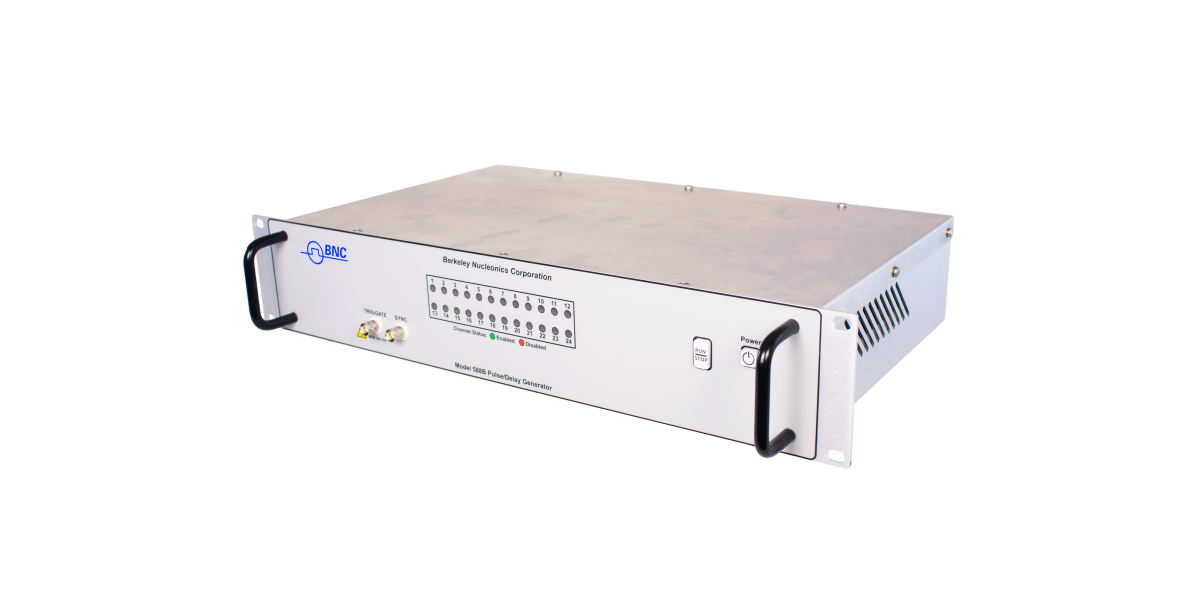
The 24-channel 588B provides twenty-four independent channels and up to thirty-six independent outputs. It holds 250 ps delay resolution and less than 5 ps RMS jitter, with timing accuracy of 1 ns + .0001 x period. Delay and width both range up to 2,000 s, which gives researchers a wide operating window from nanosecond-scale events to long acquisition sequences.
Tighter jitter matters most when several instruments fire against a shared clock. In pump-probe experiments, laser timing chains, and large synchronized test setups, timing error between channels accumulates and degrades results. The less than 5 ps RMS jitter of the 588B keeps channels aligned, so lasers, detectors, cameras, and amplifiers trigger in the intended order and at the intended moment.
Key specifications
- 24 channels, up to 36 independent outputs
- 250 ps delay resolution
- Less than 5 ps RMS jitter
- Accuracy: 1 ns + .0001 x period
- Delay range and width range up to 2,000 s
- USB, RS232, and Ethernet interfaces
- 2U 19-inch rackmount form factor
The 588B is the natural next step for engineers and researchers who have outgrown the Model 577. The 577 delivers 4 or 8 channels in a benchtop instrument. The 588B moves that timing engine into a rackmount platform, adds channel capacity to 24 channels and up to 36 outputs, tightens jitter to less than 5 ps RMS, and integrates directly into an instrument rack. For a 577 user who has run out of channels or needs to consolidate timing into a system rack, the 588B removes that constraint without a new learning curve.
“Model 577 users tell us the same thing: keep the timing performance, give me more channels, and put it in the rack,” said John Lauder, Chief Technical Officer at Berkeley Nucleonics. “The 24-channel 588B does exactly that, with jitter tight enough for demanding synchronization work.”
Built for multichannel, high-density timing
Channel count and density matter most in applications where many trigger and gate signals have to land against one shared reference. ICCD and PIV (particle image velocimetry) testing depends on synchronized camera gates and laser triggers across a dozen or more channels; running short of channels forces researchers to split timing across two or three benchtop units, and every added instrument reintroduces the timing skew a single unit is meant to remove. Radar and sonar simulation, high-speed photography, and pump-probe laser chains carry the same demand: many independent, precisely timed outputs, all driven from one reference.
The 24-channel 588B addresses that directly. Twenty-four channels and up to thirty-six outputs come from a single 2U chassis, with the less than 5 ps RMS jitter needed to keep every channel aligned as the count grows, so adding channels does not mean adding timing error.
- ICCD and PIV testing, where synchronized gate and laser triggers across many channels set measurement quality
- Laser triggering and gating, including pump-probe timing chains
- Pulsing devices under test and pump lasers
- Radar and sonar simulation
- High-speed photography
- Physics and photonics laboratories, multi-instrument synchronization, automated test systems, and defense and research timing
Availability
The Model 588B is available through Berkeley Nucleonics and its representatives worldwide. Full specifications and quote requests are on the Model 588B datasheet page. Full options and ordering details are configured with Berkeley Nucleonics.
About Berkeley Nucleonics
Berkeley Nucleonics Corporation (BNC) has been a trusted name in precision electronic instrumentation since 1963, serving defense, research, academic, and industrial customers with digital delay generators, arbitrary waveform generators, RF/microwave signal generators, pulsed power systems, and nuclear radiation detection equipment. With 60+ years of reliability and responsive technical support, BNC is flexible and listens to your application.
Media contact
Ian Parnes
Berkeley Nucleonics Corporation
ian.parnes@berkeleynucleonics.com
800-234-7858
Technical contact: Amira Sekkouty, amira.sekkouty@berkeleynucleonics.com